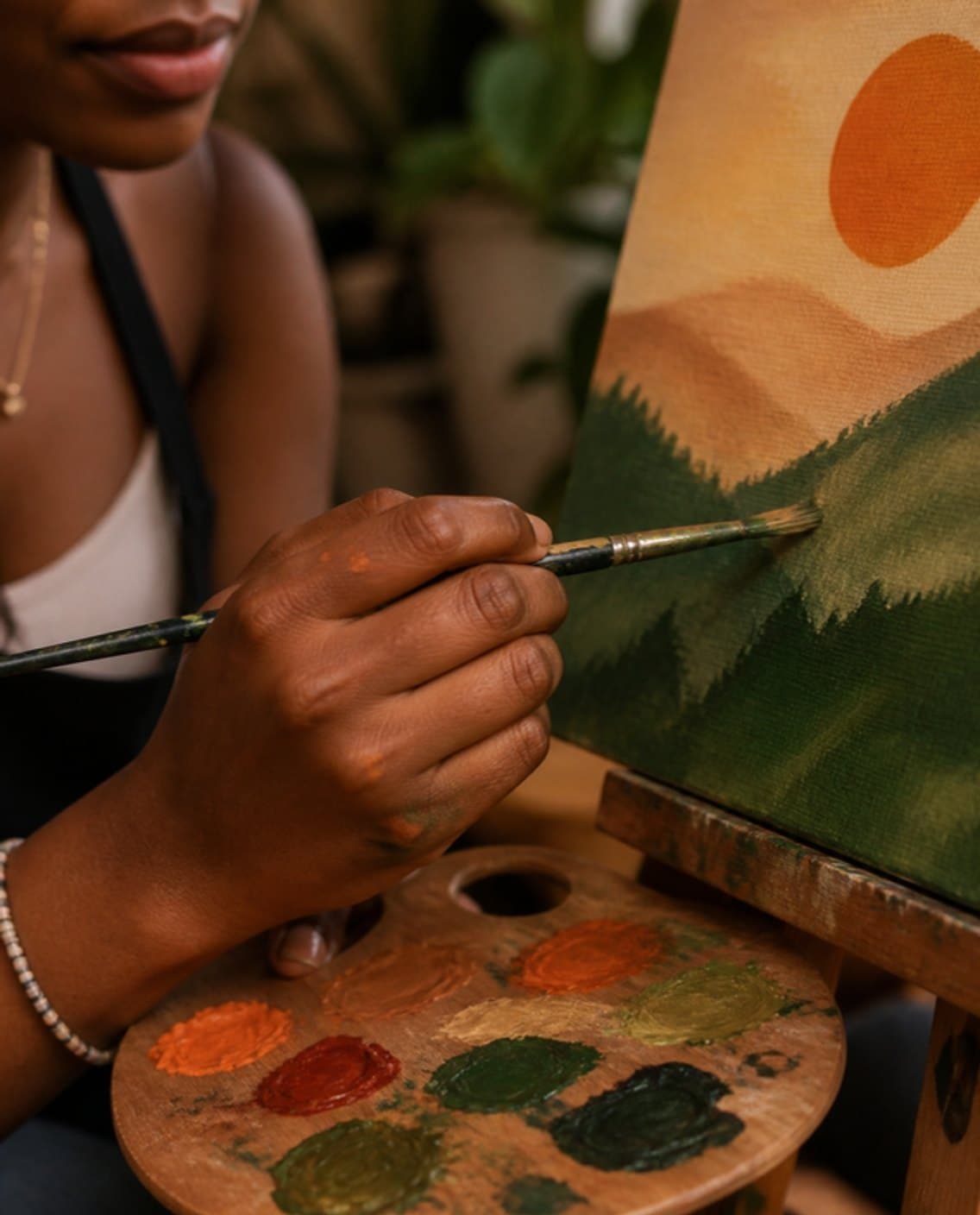
Why your mind goes quiet when you paint
It isn’t magic and it isn’t talent. Painting gives a busy brain exactly one thing to do, and that turns out to be the point.

Most of us don’t have a stress problem so much as an attention problem. The day pulls us in a dozen directions: messages, traffic, a meeting that should have been an email, the group chat that never sleeps. By evening the mind is still switching tabs, even when there is nothing left to do.
Painting interrupts that loop in a way that scrolling, or even a quiet night in, often doesn’t.
One task, all of you
When you paint, your eyes, hands and judgement all have to work on the same small problem: is this green too dark, should the line curve here, how much water is on the brush? There is no spare attention left over for rehearsing tomorrow’s conversation.
Psychologist Mihaly Csikszentmihalyi called this state “flow”: being so absorbed in a task that matches your skill that time seems to change speed. Flow tends to appear when a challenge is clear, feedback is instant and the stakes are low. A guided canvas is close to a perfect recipe for it. Every stroke shows you its result immediately, and nothing bad happens if it goes wrong.
Every stroke shows you its result immediately, and nothing bad happens if it goes wrong.
What the research says
In a 2016 study, researchers measured cortisol, a hormone linked to stress, in adults before and after 45 minutes of free art-making. Levels fell for roughly three quarters of the participants. Just as interesting: it made no difference whether people had any art experience. Beginners benefited as much as anyone.
It was a small study, and art is not a treatment for anxiety or depression. But it matches what many people describe after an evening at the easel: a heavy, pleasant tiredness, as if the mind has been tidied.
Why “no wrong strokes” matters
The calm only arrives if you stop judging. The moment painting becomes a test, the busy mind returns with a new job: grading you. That is why our sessions begin with one rule, there are no wrong strokes, and why canvases are lightly pre-sketched. Taking away the fear of a blank page leaves room for the absorbing part.
The takeaway
You don’t need to be good at painting to get the good part of painting. You need a clear, low-stakes task, a couple of unhurried hours and permission to make a mess. The quiet follows.
Sources
- Kaimal, G., Ray, K. & Muniz, J. (2016). Reduction of cortisol levels and participants’ responses following art making. Art Therapy, 33(2), 74–80.
- Csikszentmihalyi, M. (1990). Flow: The Psychology of Optimal Experience. Harper & Row.
Feel it for yourself at a CALMVAS session. No experience needed.
Join the list